CMH Specialist Hospital Radiology Service

Imaging Services


Located at ground floor of CMH Specialist Hospital. We provide diagnostic services that facilitate the provision of timely, cost-effective, and high-quality diagnostic care in safe and secure environments.

The radiology department provides imaging service 24 hours daily for inpatients, outpatients, and emergency patients of all ages

Magnetic Resonance Imagine (MRI)

What is Magnetic Resonance Imaging (MRI)?

Magnetic Resonance Imaging (MRI) is a medical imaging technique that uses a magnetic field and computer-generated radio. MRI is a non-invasive way for a medical professional to examine your organs, tissues, and skeletal system. It produces high-resolution images of the inside of the body that help diagnose a variety of conditions.

Open MRI system
Open MR imaging system designed to provide maximum patient comfort. It is equipped with a unique C-shaped magnet. This provides for easy side loading and a compact design to create an open and free atmosphere for patients. It is also equipped with extra-large coils to help accommodate obese patients and provide them with a more comfortable exam. An open MRI system doesn’t cause the same level of claustrophobia and anxiety as a closed MRI system, since the unit doesn’t fully encase your body.

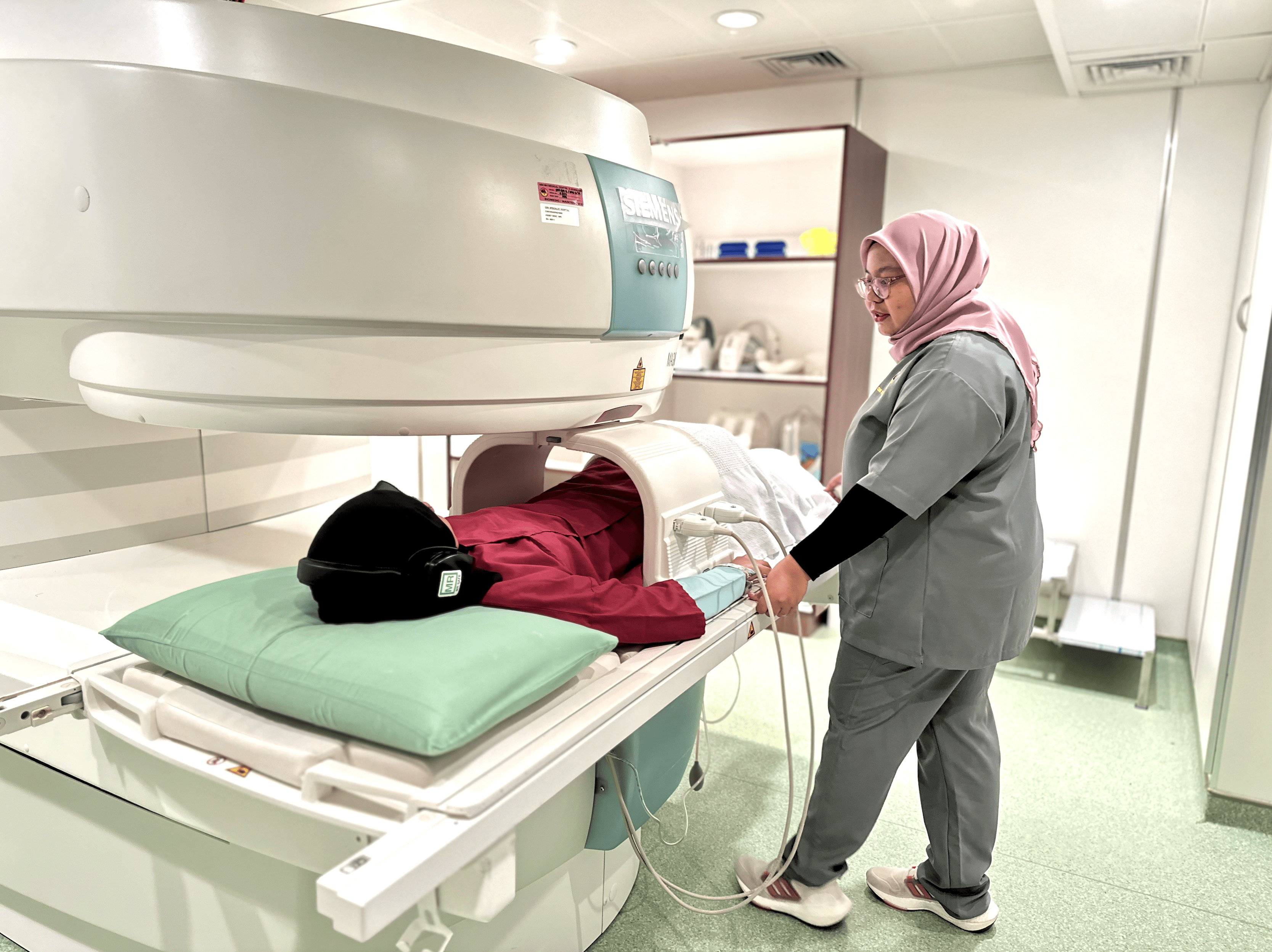
On the day of your MRI scan, you should be able to eat, drink, and take any medication as usual, unless you’re advised otherwise. 

  • When you arrive at the hospital, you’ll usually be asked to fill out a questionnaire about your health and medical history. This helps the medical staff ensure you have the scan safely.
  • As the MRI scanner produces strong magnetic fields, it’s important to remove any metal objects from your body, such as watches, jewellery, hairpins, eyeglasses, dentures, hearing aids, and cosmetics that contain metal particles.
  • Depending on which part of your body is being scanned, you may need to wear a hospital gown during the procedure. If you don’t need to wear a gown, you should wear clothes without metal zips, fasteners, buttons, underwires (bras), belts, or buckles.

Computed Tomography Scan (CT Scan)

What is a Computed Tomography Scan (CT Scan)?

A computerized tomography scan, also called a CT scan, is an advanced X-ray technique that uses computer technology together with x-rays to provide high-resolution 3D images of the internal organs of the body. With these high-resolution 3D images, the radiologist and clinician can make a more precise diagnosis or surgical planning

Depending on which part of your body is being scanned, you may be asked to: 

  • Take off some or all your clothing and wear a hospital gown.
  • Remove metal objects, such as belts jewellery, dentures, and eyeglasses that might affect image results.
  • Not eat or drink for a few hours before your scan.
  • Contrast media could be given. These substances can be administered orally, rectally, or intravenously.

A special dye called contrast agent is needed for some CT scans. The dye appears bright on images. So it makes certain areas of the body that are being scanned show up better. This can help make blood vessels, intestines, or other structures easier to see.

3D MAMMOGRAM

What is a 3D Tomosynthesis mammogram?

Tomosynthesis or “3D” mammography is a new type of digital x-ray mammogram that creates 2D and 3D-like pictures of the breasts. This tool improves the ability of mammography to detect early breast cancers.

  • You need to wear a hospital gown during the procedure.
  • On the day of the exam, don’t apply deodorant, antiperspirant, powders, lotions, creams, or perfumes under your arms or on or under your breasts. Some of these contain substances that can show up on the x-ray as white spots.
  • Avoid scheduling your mammogram at a time when your breasts are swollen or tender, such as right before your period.
  • At least 40 years old.
  • Never had a mammogram before or the last mammogram was more than two (2) years old.
  • If you have close female relatives with a strong family history of breast cancer (mother, sister, daughter, aunt, grandmother, or great-aunt).

X-RAYS

What is X-rays?

 X-rays are a form of electromagnetic radiation, similar to visible light. Unlike light, however, x-rays have higher energy and can pass through most objects, including the body. Medical x-rays are used to generate images of tissues and structures inside the body. If x-rays travelling through the body also pass through an x-ray detector on the other side of the patient, an image will be formed that represents the “shadows” formed by the objects inside of the body.

ULTRASOUND

What is Ultrasound?

Ultrasound is a non-invasive imaging test that shows structures inside your body using high-intensity sound waves. Ultrasound, also called sonography. The images can help guide diagnosis and treatment for many diseases and conditions.

OUR RADIOLOGISTS: